
Chicago, IL 60611 United States
Workshop Organizers
Khanh Dao Duc – University of British Columbia
Shira Faigenbaum-Golovin – Bar Ilan University
Ashok Prasad – Colorado State University
Matheus Palhares Viana – Allen Institute for Cell Science
Wenjun Zhao – Wake Forest University
Felix Zhou – University of Texas Southwestern Medical Center


Overview
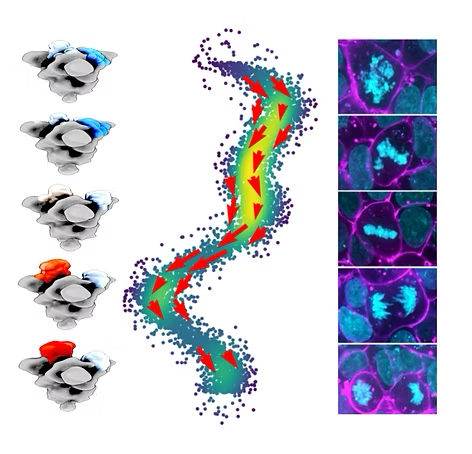
Advances in high-throughput imaging techniques now generate massive amounts of multiscale image data, ranging from whole tissues to single cells to protein structures. Beyond static snapshots, novel imaging methods capture long time-series that provide valuable spatio-temporal information. Analyzing this unprecedented volume of biological data raises a variety of mathematical challenges. Notably, how can we model biological variation while disentangling biological variation from technical heterogeneity? For example, how do single cells grow and progress through the cell cycle under diverse stimuli, or how do proteins and molecular complexes undergo conformational changes? Despite the richness of these data, methods for spatio-temporal analysis remain limited in computational biology. At the same time, tools from multiple disciplines—such as deep learning in computer science, mechanistic models in biophysics, and dynamical systems theory in mathematics—have been developed to study related problems. In this context, our proposed workshop will focus on theoretical and computational tools from mathematics and physics that enable rigorous analysis of spatio-temporal biological data, with the goal of elucidating the temporal dynamics of underlying biological processes.
Intended for a diverse audience of mathematicians, physicists, and computational and experimental biologists, the workshop will feature complimentary sessions on different facets of imaging data, with a particular focus on dynamics. Our interdisciplinary organizing team will begin with a general overview of shape space, highlighting both theoretical foundations and state-of-the-art computational tools. We will then present several publicly available datasets on protein and cell shapes from advanced imaging experiments, and brainstorm methods to uncover the dynamics underlying observed heterogeneity. The ultimate goal of the workshop is to develop a blueprint for new frameworks to study dynamics in shape space and to foster collaborations across mathematics, computer science, and biology.
Participants
Organizers
- Khanh Dao Duc – University of British Columbia
- Shira Faigenbaum-Golovin – Bar Ilan University
- Matheus Palhares Viana – Allen Institute for Cell Science
- Ashok Prasad – Colorado State University
- Wenjun Zhao – Wake Forest University
- Felix Zhou – University of Texas Southwestern Medical Center
Participants
- Zixuan Cang – North Carolina State University
- Willem Diepeveen – University of California, Los Angeles
- Alex Eskandarian – Harvard Medical School
- Keisuke Ishihara – University of Pittsburgh
- Ed Jenkins – University of Oxford
- Ioannis Sgouralis – University of Tennessee Knoxville
- Anuj Srivastava – Johns Hopkins University
- Julie Theriot – University of Washington
- Aaron van Loon – University of Washington
- Clarence Yapp – Harvard Medical School
- Laurent Younes – Johns Hopkins University